
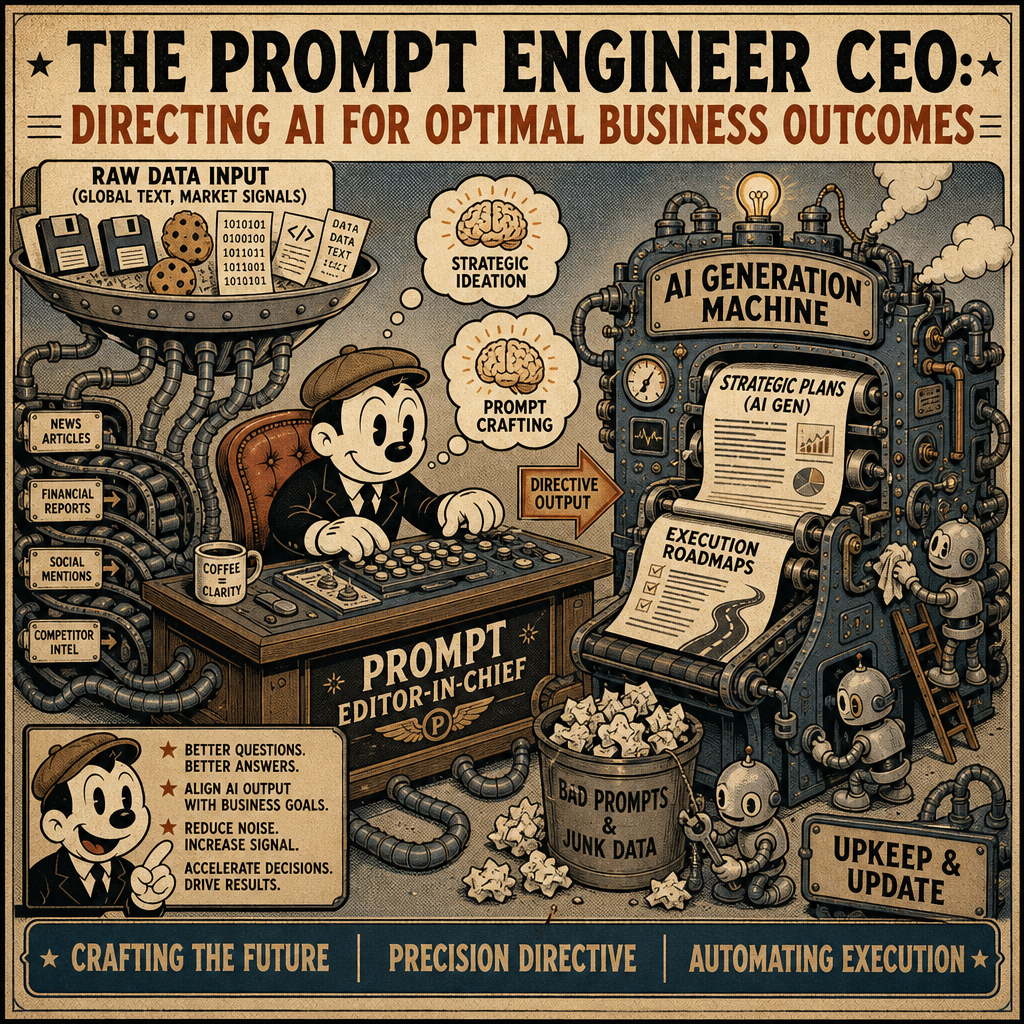
Why Your CEO Needs to Become a Prompt Engineer
For decades, the mark of a successful CEO was the ability to ask the right questions of their human advisors. They relied on middle management to synthesize data, filter noise, and present curated insights for decision-making. In the era of generative AI, that model is undergoing a radical shift. Today, the most vital skill in the boardroom is not just leadership; it is prompt engineering.
At Exponential Agility, we view prompt engineering not as a technical chore for developers, but as a strategic competency for executives. When a CEO learns how to query a Large Language Model (LLM) effectively, they are essentially unlocking a direct line to the collective intelligence of the internet. They are transforming a static database into a dynamic, sparring partner that can stress-test business strategies in real time.
Consider the traditional process of market analysis. It often involves weeks of research, consultancy reports, and internal briefings. By the time the data hits the CEO’s desk, the market landscape may have already shifted. A CEO who is proficient in prompt engineering can bypass those delays. They can feed raw data into an LLM and request specific, multidimensional analyses—identifying competitive threats, simulating customer reactions to new pricing models, or stress-testing supply chain vulnerabilities.
However, the quality of the output is entirely dependent on the quality of the input. This is where the art of the prompt becomes a business imperative. A vague prompt leads to generic, surface-level suggestions. A sophisticated prompt, which frames context, constraints, and desired logical frameworks, yields actionable intelligence that can fundamentally alter the trajectory of a company. It is about learning how to guide the machine to think alongside you, rather than just retrieving information for you.
When a CEO masters prompting, they gain an exponential advantage in agility. They can iterate on strategy at the speed of thought. They can see around corners by asking their AI to play the devil advocate against their own plans. They move from being a consumer of reports to being an architect of inquiry.
The barrier to entry for this technology is lower than ever, but the barrier to mastery is high. It requires a fundamental shift in how leaders frame problems. If your executive team is still waiting for others to translate the world for them, you are already falling behind. The future of leadership belongs to those who know how to speak the language of the machine to extract the wisdom of the world.

Related Posts

People Of The Rain.

People Of The Rain.