Why 70% of CEOs Will Be Replaced by AI-Driven Decision Models
The era of the gut-feeling executive is drawing to a close. For decades, leadership has been defined by intuition, experience, and the ability to navigate ambiguity through personal judgment. However, the rapid evolution of artificial intelligence is fundamentally rewriting the job description of the C-suite. At Artilecto, we are observing a seismic shift: the transition from intuition-based leadership to autonomous, data-driven decision models.
Current projections suggest that within the next decade, up to 70 percent of traditional CEO functions will be replaced or significantly augmented by AI-driven systems. This is not a dystopian narrative about the end of human leadership; rather, it is an evolution toward a more precise, scalable, and objective form of management.
Why is this shift happening? The primary driver is the sheer complexity of modern global business. Human cognitive capacity is limited. We struggle to process millions of data points, real-time market fluctuations, supply chain variables, and consumer sentiment simultaneously. AI does not suffer from these limitations. Autonomous decision models can simulate thousands of outcomes in seconds, identifying risks and opportunities that remain invisible to the human eye.
When a CEO relies on intuition, they are susceptible to cognitive biases—the silent killers of corporate strategy. Confirmation bias, overconfidence, and the sunk-cost fallacy often derail even the most well-intentioned leaders. AI-driven models operate on logic and pattern recognition, effectively stripping emotion from the equation. This leads to higher margins, better resource allocation, and a level of operational agility that was previously impossible.
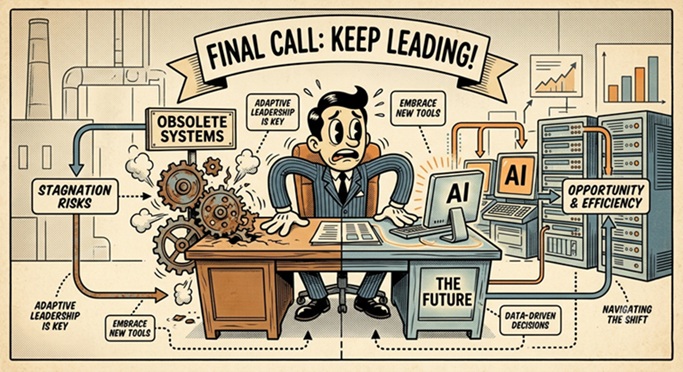
The implications for the C-suite are profound. The future leader will not be the person making the most decisions, but the person who best orchestrates the autonomous systems driving those decisions. The role is shifting from that of a captain steering a ship to that of an architect designing the engine. Executives who cling to the old model of high-level intuition will find themselves outpaced by competitors who have embraced algorithmic strategy.
This transformation requires a new skillset. Tomorrow’s leaders must be data-literate, comfortable with machine learning integration, and capable of managing the ethical implications of autonomous systems. The goal is not to remove the human element entirely, but to elevate human judgment to higher-order creative and cultural tasks, leaving the heavy lifting of operational decision-making to the machines.
The question is no longer whether AI will run your business, but how quickly you can adapt your leadership model to thrive in an autonomous future. Companies that fail to integrate these models will find their decision-making cycles too slow and their strategies too inaccurate to survive in the exponential age.
Is your leadership team ready to transition from intuition to intelligence? Contact Artilecto today to learn how to integrate AI-driven decision models into your corporate strategy.