
3 Ways AI is Reshaping Boardroom Decision Making
The role of the modern CEO is evolving at an unprecedented pace. In an era defined by volatility and rapid market shifts, relying on intuition alone is no longer a viable strategy for long-term success. At Exponential Agility, we are seeing a fundamental shift in how leadership teams operate. Artificial intelligence is moving from the back office to the boardroom, transforming how executives process information and chart the future of their organizations.
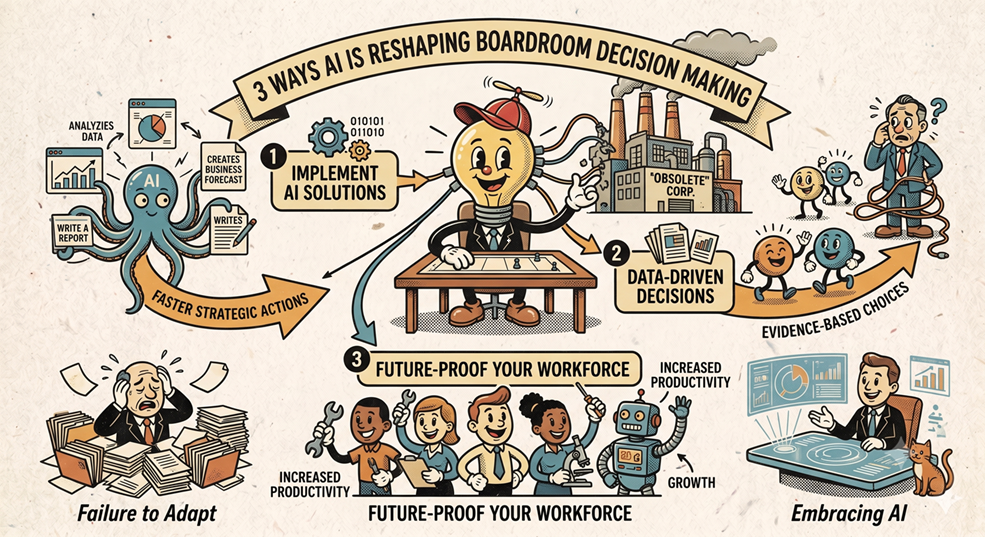
Here are three ways AI is reshaping boardroom decision making today.
First, AI enables real-time synthesis of complex data sets. Historically, board members relied on quarterly reports that reflected past performance. Today, AI-driven analytics platforms aggregate internal operational data with external market trends, sentiment analysis, and competitor movements in near real-time. This allows CEOs to move away from reactive post-mortems and toward proactive, predictive strategy. By the time a board meeting begins, every member is already aligned on the current state of the business, backed by a single, verified version of the truth.
Second, AI is removing cognitive bias from high-stakes decision making. Even the most seasoned executives are prone to confirmation bias or groupthink. AI tools can stress-test strategic hypotheses by running thousands of simulations based on varying economic conditions. By presenting counter-factual scenarios and identifying hidden risks that a human might overlook, AI acts as an objective devil advocate. This leads to more robust, stress-tested strategies that are far less likely to crumble under unforeseen market pressures.
Third, AI is significantly accelerating the speed of execution. When data is fragmented, the delay between identifying an opportunity and taking action can be weeks or months. AI-powered dashboards provide instant insights, allowing leadership to pivot resources, adjust pricing models, or enter new markets with confidence. For a CEO, this means the gap between strategic intent and operational execution is narrowed, creating a competitive advantage that is difficult for slower, legacy-driven firms to replicate.
The integration of AI into the boardroom is not about replacing human judgment; it is about augmenting it. By leveraging these technologies, CEOs can focus their energy on high-level vision and culture, leaving the heavy lifting of data synthesis and risk modeling to the machines. As we continue to navigate a complex global landscape, the organizations that embrace this data-backed approach will be the ones that define the next generation of industry leaders.
Is your leadership team ready to leverage the power of AI to drive better strategic outcomes? Reach out to Artilecto today to learn how we can help you integrate data-backed insights into your boardroom strategy.

Related Posts

People Of The Rain.

People Of The Rain.