
Why Your AI Project Failed: A CEO’s Post-Mortem
The boardroom buzz around artificial intelligence is deafening. Everyone wants to be an AI-first company, but the reality is that most AI initiatives end in quiet, expensive disappointment. As leaders, we often look for technical scapegoats when projects stall. We blame the data scientists, the legacy infrastructure, or the vendor. However, the true culprit is almost always leadership failure.
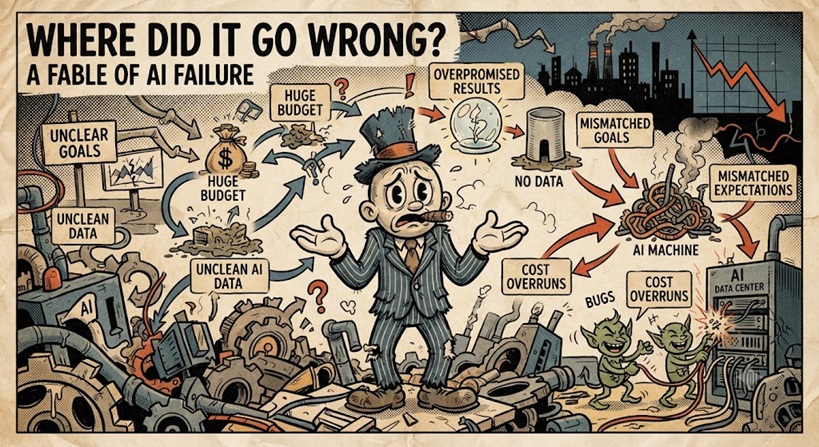
The most common reason for failure is a lack of clear, business-driven objectives. Many CEOs approach AI like a shiny new toy. They task their teams with implementing machine learning or generative models without defining the specific problem they are trying to solve. If you cannot articulate how an AI tool increases revenue, reduces operational costs, or improves customer retention, you are not doing strategy; you are doing experimentation with a massive budget.
Another major pitfall is the disconnect between the C-suite and the practitioners. Leadership often treats AI as an IT project that can be outsourced to a vendor or delegated to a department head. Successful AI adoption requires an organizational shift in culture. If your leadership team does not understand the limitations and dependencies of the technology, you will set unrealistic expectations. Projects fail when stakeholders expect magic, only to be met with the messy, iterative reality of training models and cleaning data.
Furthermore, many AI projects suffer from a lack of data readiness. You cannot build a skyscraper on a swamp. If your data is siloed, messy, or biased, your AI will simply scale your existing inefficiencies. Leaders must prioritize data governance and infrastructure as foundational investments, not afterthoughts. A project that ignores the hygiene of the underlying data is destined to collapse under its own weight.
Finally, failure often stems from a lack of agility in the implementation process. AI is not a waterfall project where you define requirements once and wait for a finished product. It requires a mindset of rapid prototyping, testing, and pivoting. When leadership demands rigid timelines and fixed outcomes for a technology that is inherently probabilistic, they kill the very innovation they are trying to foster.
Admitting that a project failed is painful, but it is also the most valuable data point you have. If your AI initiative stalled, stop looking at the algorithms and start looking at the strategy. Did you have a clear goal? Did you involve your cross-functional teams early? Did you treat it as a business transformation rather than a software update?
If you are ready to stop experimenting and start delivering measurable value, let us refine your approach.
Contact Exponential Agility today to schedule a strategic review of your AI roadmap.

Related Posts

People Of The Rain.

People Of The Rain.