
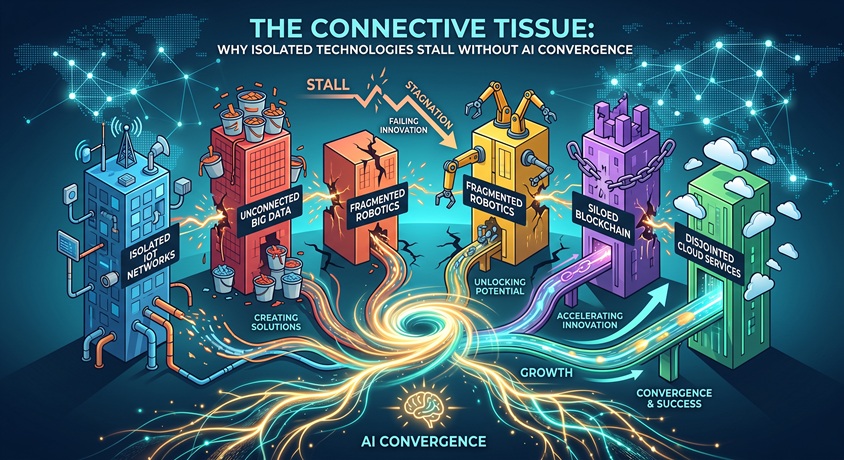
The Connective Tissue: Why Isolated Technologies Stall Without AI Convergence
We live in an era of extraordinary technological acceleration. Quantum computing promises to rewrite the laws of cryptography and molecular modeling. Biotechnology unlocks gene editing tools that can eradicate hereditary diseases. Advanced robotics creates machines with unprecedented dexterity and spatial awareness. Yet, despite these monumental leaps, progress often feels frustratingly fragmented. Each breakthrough exists in a vacuum, held back by the sheer complexity of translating discoveries from one domain into another.
The root of this stagnation is not a lack of innovation. It is a lack of integration. Quantum physicists speak a different dialect than molecular biologists, and roboticists rarely optimize their hardware for the nuances of synthetic biology. These fields operate as isolated silos, hoarding data and methodologies. Without a common language, the timeline from laboratory discovery to real-world application stretches out for decades. We do not need more isolated brilliance; we need a unifying force to bridge the gaps.
Enter artificial intelligence, not merely as another vertical tool, but as the horizontal orchestrator of the modern scientific revolution. AI functions as the connective tissue of advanced tech. By processing multi-petabyte datasets across disparate disciplines at machine speed, artificial intelligence identifies hidden correlations that human researchers miss. It translates the probabilistic outputs of quantum algorithms into actionable parameters for biotech wet labs, while simultaneously optimizing the mechanical execution pathways for robotic systems.
Consider how drug discovery changes when AI converges with quantum and bio tech. A quantum computer simulates molecular interactions at an atomic level, generating a tsunami of complex data. Left alone, human teams would spend years parsing these results. An AI layer ingests this quantum output, designs targeted gene therapies based on the findings, and programs laboratory robots to synthesize and test the compounds autonomously. The isolated technologies suddenly become a synchronized assembly line of discovery.
This convergence transforms artificial intelligence from a clever software utility into the foundational operating system of future innovation. Breakthroughs will no longer stall in transit between theoretical physics and applied engineering. As AI breaks down the walls separating these disciplines, the pace of problem-solving will accelerate exponentially. The future belongs not to the specialists working in isolation, but to the architects of convergence.
Are you ready to build the future of connected innovation? Contact Artilecto today to discover how our AI-driven strategies can unify your technology stack.

Related Posts

People Of The Rain.

People Of The Rain.