
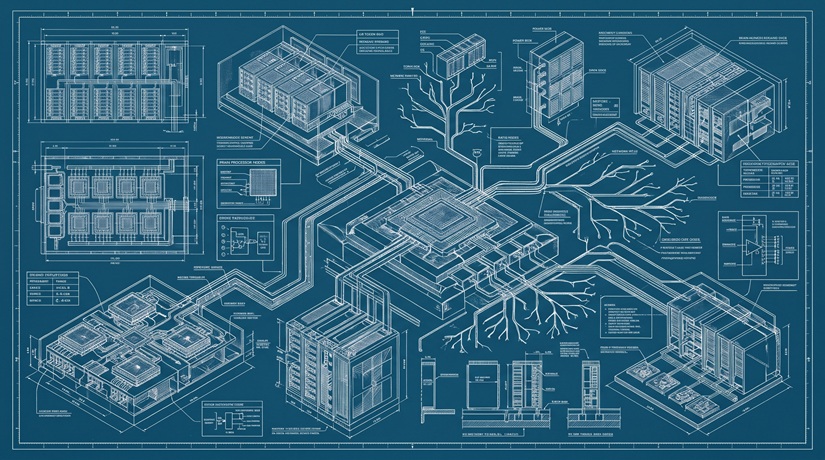
Neuromorphic Datacenters: The Foundation of the $4T Supercycle
The artificial intelligence infrastructure supercycle is hurtling toward a hard physical wall. As tech giants pour trillions of dollars into building massive AI clusters, a terrifying bottleneck looms on the horizon. Current datacenters consume staggering amounts of electricity, and the global power grid simply cannot sustain the projected load. Traditional von Neumann architectures, which separate memory and processing, are reaching their thermodynamic limits. To fuel the next phase of the AI revolution, the industry must pivot to a fundamentally different paradigm.
Enter neuromorphic computing and photonic chips. Unlike conventional silicon processors that shuffle data back and forth across vast distances, neuromorphic systems mimic the architecture of the human brain. They integrate memory and processing into dense, interconnected networks of synthetic synapses and neurons. When combined with silicon photonics, which use light instead of copper wires to transmit data, these chips achieve unprecedented speeds while slashing energy consumption by orders of magnitude.
This technological leap is not just an incremental upgrade; it is the absolute foundation of the four trillion dollar supercycle. Without neuromorphic datacenters, the expansion of artificial intelligence will stall due to brownouts, grid failures, and unsustainable operational costs. The human brain operates on roughly twenty watts of power while performing complex multimodal reasoning. Neuromorphic engineering seeks to replicate this extreme efficiency in server racks, transforming how hyperscalers approach cooling, power distribution, and spatial layout.
For investors and enterprise leaders, understanding this shift is critical. The race to build the next generation of AI hardware is shifting away from brute-force scaling toward brain-inspired efficiency. Companies that master neuromorphic photonics will dictate the terms of the digital economy for decades to come, while those clinging to legacy architectures will find themselves priced out of the energy market. The future of intelligence is biological in inspiration, photonic in execution, and utterly essential for planetary survival.
Are you prepared for the neuromorphic revolution? Subscribe to Artilecto for deep dives into the technologies reshaping our world.
