
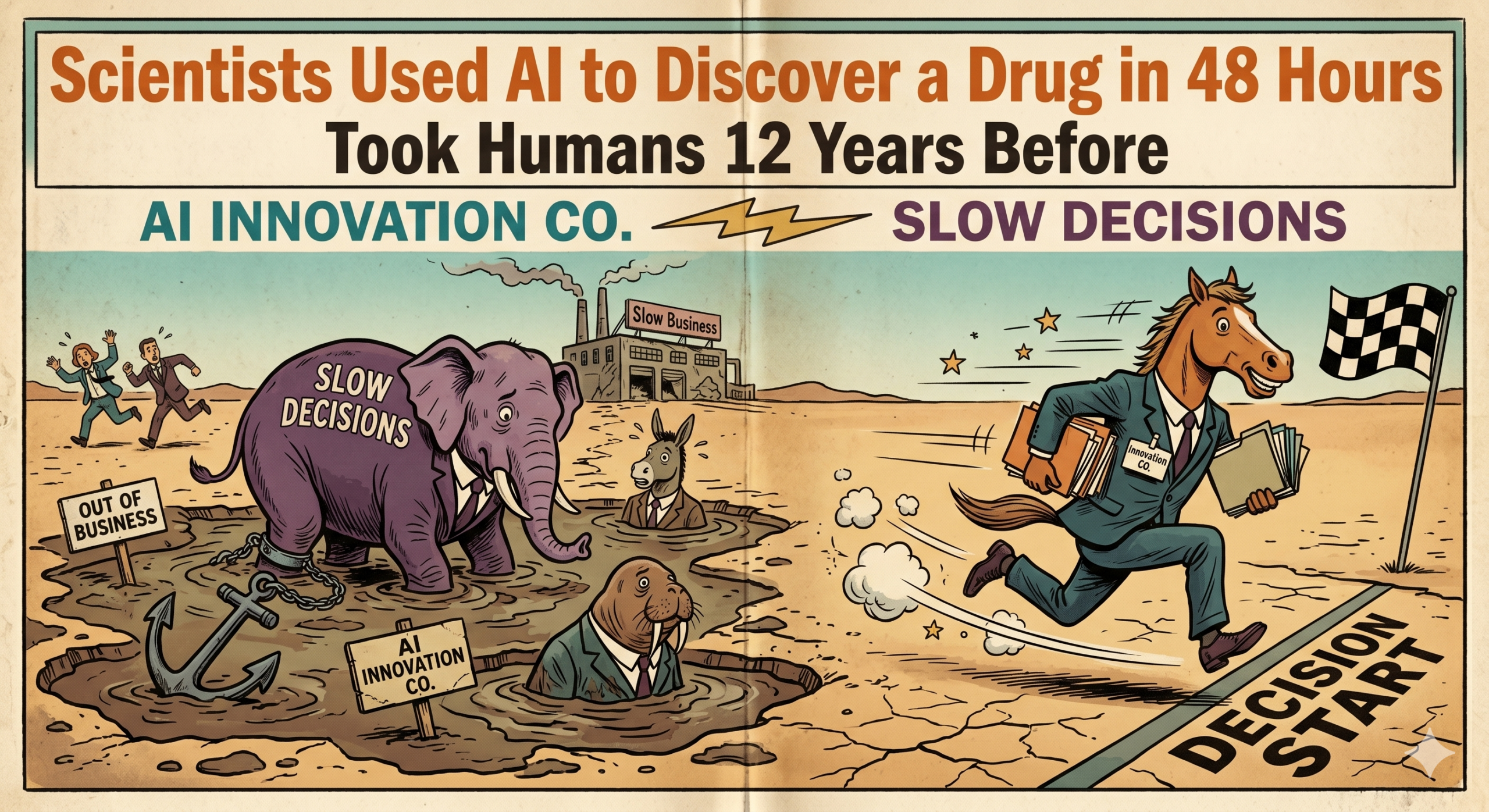
Scientists Used AI to Discover a Drug in 48 Hours That Took Humans 12 Years Before
What used to take a decade now takes a weekend. That sentence would have sounded like science fiction five years ago. Today, it’s simply Tuesday in the world of AI-accelerated drug discovery.
In a landmark case that sent shockwaves through the pharmaceutical industry, researchers using AI identified a promising drug candidate for a previously “undruggable” protein target in just 48 hours. The traditional path to the same discovery had taken human scientists over 12 years of painstaking trial and error. Same destination. Dramatically different journey.
So what’s actually happening under the hood?
Traditional drug discovery works like searching for a specific grain of sand on every beach on Earth. Scientists must identify a disease target, then screen millions of chemical compounds to find one that interacts with it correctly, then test for toxicity, then optimize the molecular structure, then test again. Each step bleeds into years.
AI flips this process almost entirely. Machine learning models trained on vast libraries of molecular data can predict how a compound will behave before a single lab test is run. Tools like AlphaFold, which cracked the protein-folding problem that stumped scientists for 50 years, give researchers an accurate 3D map of disease targets. Generative AI then designs new molecules specifically shaped to interact with those targets. It’s not guessing. It’s informed, iterative, and blindingly fast.
The implications reach far beyond speed.
Drug discovery has always been brutal on budgets. Bringing a single drug to market traditionally costs over $2 billion and still carries roughly a 90 percent failure rate in clinical trials. AI doesn’t eliminate failure, but it front-loads the intelligence. Bad candidates get filtered out early, before expensive human trials begin. That changes the economics of medicine in ways we’re only beginning to calculate.
It also changes who gets access to cures.
Rare diseases, sometimes called orphan diseases, affect small patient populations and have historically attracted little pharmaceutical investment because the math didn’t work. When discovery costs drop dramatically, the calculus changes. Conditions that pharmaceutical companies once ignored because they weren’t profitable enough to pursue are now entering research pipelines. That’s not a small thing. For millions of people with conditions that have had no treatment options, AI may be the first real reason for hope.
We’re also seeing AI collapse timeframes in antibiotic research, cancer treatment, and neurological conditions like Alzheimer’s, where the complexity of the disease has defeated conventional approaches for generations.
None of this means AI replaces scientists. The researchers guiding these systems, interpreting outputs, designing experiments, and navigating regulatory approval are still essential. What AI does is remove the ceiling on what a small, focused team can accomplish. A group of researchers that once might have investigated a handful of compounds in a year can now explore thousands.
The 48-hour drug discovery story isn’t an anomaly. It’s a preview.
The question for business leaders, healthcare investors, and anyone paying attention to where technology is taking us isn’t whether AI will transform medicine. It already is. The question is whether your organization is positioned to understand and act on what’s coming next.
At Exponential Agility, we help leaders build the frameworks to think clearly about exponential change before it disrupts them. If you want to understand how breakthroughs like this one affect your industry and your strategy, let’s start that conversation today.

Related Posts

People Of The Rain – Future Vision XPRIZE.
People Of The Rain – Future Vision XPRIZE.