The Silent AI Revolution: How CEOs Are Using Agents to Cut Costs
For decades, the corporate playbook for scaling operations was simple: hire more people. As companies grew, they added layers of middle management to oversee workflows, manage communication, and bridge the gap between strategy and execution. Today, that model is undergoing a radical, silent transformation. CEOs are no longer looking to expand headcount to handle increased volume; they are looking to AI agents.
We are moving past the era of the chatbot—those simple tools that only answer basic customer questions. We have entered the age of autonomous AI agents. Unlike static software, these agents are goal-oriented. They can navigate complex workflows, interact with enterprise software, interpret data, and make decisions within defined parameters. They do not need sleep, they do not suffer from administrative fatigue, and they do not require the overhead of traditional management.
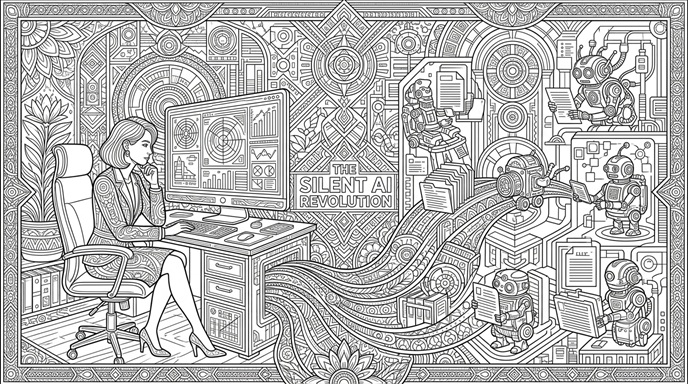
The shift is most visible in operational efficiency. Consider the typical middle-management workflow: project tracking, progress reporting, resource allocation, and status updates. These tasks are essential, but they are also repetitive and prone to human error. AI agents are now assuming these responsibilities. By integrating directly into platforms like Slack, Jira, or Salesforce, agents can monitor project health in real-time, flag bottlenecks before they become crises, and automatically reassign tasks based on capacity.
This transition is not about replacing human creativity or high-level strategy. Instead, it is about eliminating the human-heavy middle layer that often slows down organizational agility. When an AI agent manages the flow of work, information moves at the speed of silicon rather than the speed of a weekly status meeting. The result is a leaner, more responsive organization that can pivot instantly in a volatile market.
For CEOs, the financial implications are profound. Reducing the reliance on large middle-management teams significantly lowers operating costs while simultaneously increasing output velocity. However, this shift requires a new kind of leadership. It demands a move from managing people to managing systems. Executives who learn to architect these agentic workflows will find themselves with a massive competitive advantage, operating at a fraction of the cost of their legacy-bound peers.
The silent revolution is already underway. The companies that thrive in the coming decade will be those that view AI not as a tool for their employees to use, but as an autonomous layer of their operational structure. If your organization is still relying on human-heavy processes for routine coordination, you are carrying a weight that your competitors are rapidly shedding.
Is your business ready to embrace the agentic shift? Contact Artilecto today to audit your operational workflows and start building your autonomous future.