
Cracking the Code of Global Hunger with Exponential Tech
Humanity faces an unprecedented collision of climate crisis and population growth. Traditional agriculture, bound by centuries-old breeding cycles, simply cannot adapt fast enough to feed a rapidly warming planet. Enter exponential technology. By merging artificial intelligence with synthetic biology, we are no longer waiting on evolution. We are designing the future of food from the ground up, at lightning speed.
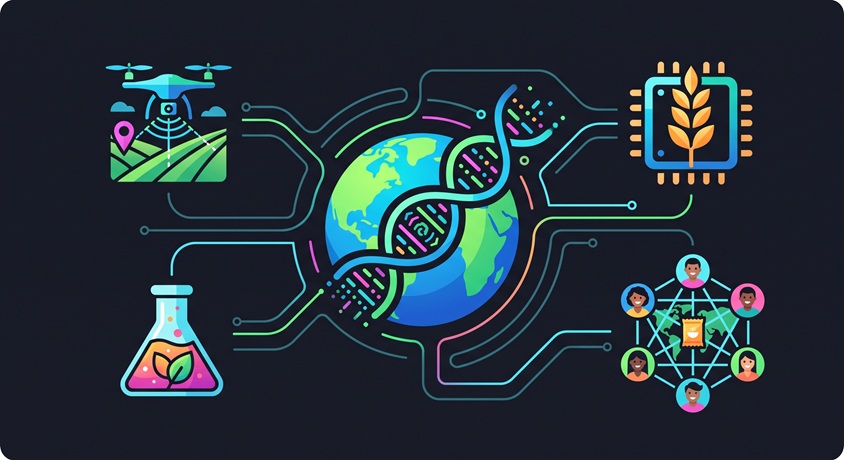
At the heart of this agricultural revolution is AI-driven synthetic biology. For generations, developing a single drought-resistant crop variety took decades of trial and error in the fields. Today, advanced machine learning models can simulate millions of genetic combinations in a matter of hours. These algorithms sift through massive genomic datasets to identify the exact gene sequences responsible for water retention, heat tolerance, and enhanced nutrient uptake.
Once the AI cracks the genetic code, synthetic biology steps in to write it. Scientists can precisely edit plant genomes with unprecedented accuracy or synthesize entirely new pathways that help crops thrive in parched, nutrient-poor soils. We are talking about staple crops like wheat, rice, and maize engineered to withstand severe droughts that would normally decimate entire harvests. This is not about modifying nature for profit; it is about programming resilience for survival.
The scale of potential impact on global food security is staggering. As climate change turns arable land into dust, these hyper-resilient crops offer a lifeline to billions of people in vulnerable regions. By drastically cutting down development timelines from decades to months, we can stay a step ahead of environmental collapse. This convergence of exponential technologies transforms food production from a fragile gamble into a predictable, scalable science.
We stand on the brink of eradicating food insecurity for good, but unlocking this future requires bold action and investment. How will your organization embrace exponential tech to solve our most critical planetary challenges? Share your thoughts in the comments below and join the Artilecto community today.

Related Posts

People Of The Rain.

People Of The Rain.