

People Of The Rain – Future Vision XPRIZE.
Vision, Creation and its Constant Regeneration.
From Mexico, I wrote People Of The Rain, a story about a water-scarce future that I entered into Future Vision XPRIZE. Below, I share the lessons learned from building the story and creating the video piece.
You can watch the video here: youtu.be/MMIuj8ndHj0 — and the full treatment here: drive.google.com/file/d/10RNUGJfPk5ZCj1EajZC7wmsG44-3Hhea/view.
By the numbers: 6 months of incremental dedication — 2, 4, 8, and 16–20 hours (final month) per day heading into the delivery deadline — running across three parallel tracks (not sequential phases). Discovery (thesis, research, cultural documentation in Gemini Notebook from month one) never fully closes: it feeds back into the project from start to finish. Delivery kicked off in July, with Google AI Ultra, Grok Heavy, Claude, and ElevenLabs all active. Distribution was the final package for XPRIZE. Each of the 7 complete cut versions went through a 5-dimension quality-assurance instrument —thesis, evidence, narrative tension, specificity, structure— before moving to the next. Result: 30 final shots out of several times more discarded generations (close to 200 takes) · 17 full script versions · 8 cut versions · 20 voice takes (17 Remedios + 3 Citlali) plus discarded takes · 3 original music tracks plus discarded takes · a single shot — Shot 29 — that took more than 8 rounds to get right.
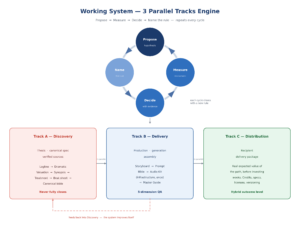
The engine of the Work System that held all of this together: three parallel tracks, with Discovery feeding back into the whole system on every cycle.
What follows is not an ideological stance or a political prescription — these are lessons from an exercise in extreme learning (non-technical insights drawn from evaluating each of the 7 video versions that were generated): thinking with critical responsibility before a decision impacts, for better or worse, someone else’s life.
Administering that creation also means taking on the responsibility of sustaining a system of side effects — ones that impact, for better or worse, humanity’s progress.
What we must always be careful about is never tampering with anything whose failure isn’t an experiment, but harm. Reaching the goal is no reason to lose our humanity.
Telling that story surfaced a proposal:
Designing a future “today” means creating, in parallel and intentionally, the capacity to choose again — so the vision can regenerate as the solution instrument —a new invention built with accelerating technologies to solve one of the 12 global challenges— changes, without betting the foundation: the operations and the people who have to stay standing while that vision gets rewritten.
The underlying idea is twofold and doesn’t split: find an instrument and, at the same time, regenerate a vision that positively impacts the quality of life of any being on Earth. If only the instrument survives, what’s left is an object. If only the talk survives, what’s left is a season. You need both: an instrument that works now, and a vision that can be rewritten once that instrument is no longer enough.
This same logic —instrument plus regenerable vision— could be the foundation of public policy, not just of an individual project.
Fiction forces you to choose what you celebrate. If the camera falls in love with the first instrument, the story’s inheritance is an object. If it falls in love with whoever can change it without everyday life falling apart, the story’s inheritance is a habit. People Of The Rain went with the second.
Technology doesn’t wait. This quarter’s AI isn’t next quarter’s. Energy, data, health: the same. What ages badly isn’t the solution — it’s staying married to the first version we happened to like.
Company, government, or NGO: origin doesn’t decide whether a vision is serious. What decides it is whether it can admit the next curve… and whether what must not fail —people, operations— is taken care of.
During the development of the full script, we realized something else is missing: today’s organizational structures for decision-making don’t have the agility needed when new dilemmas appear —something Norbert Wiener, the MIT mathematician who founded cybernetics, already identified in 1950 as the hardest case in technology ethics: unfamiliar situations resolved with never-before-seen means, with no existing principles to apply directly. His method remains valid for analyzing the problem. What’s missing today is solving it in time: it’s not enough to have the advances that accelerating solutions or technologies bring — we also need to change how decision-making itself is organized, so it’s fast, sustained, and immediately serves the people affected.
Twenty years from now, it won’t matter whether the story “guessed” the right instrument. What will matter is whether a habit remained —one born from exponential thinking—: regenerating the vision and the instrument in service of quality of life. And whether that habit can be practiced by others, not just those of us who wrote the first cut or built the first version.
The finding
I’ve been working on exactly that question across two projects: a short film about water in the Mixteca region of Oaxaca, and another about energy in the Peruvian Andes. Both are fictional stories about the future, built on technologies and deployments that are very real —research into how to make them feasible and put them into motion as real projects: PoTR, atmospheric water generation; LATIDO, self-sufficient sustainable electric energy generation. But building them with the same method, over and over, the same pattern kept showing up — and that pattern no longer talks only about film. It talks about how any accelerating technology should enter anywhere in the world.
In the Mixteca’s story, masts capture water from the air. In the Andes’ story, a small reactor solves the energy needs of an entire town. These are different technologies, on different continents, solving different problems. And yet, both stories arrived at the same conclusion, each on its own:
A new technology doesn’t improve people’s lives because of how advanced it is. It improves them when the people receiving it can decide whether they want it, learn to use it, turn it off if it no longer serves them, and don’t have to change who they are in order to have it.
Put another way: it doesn’t matter how good the technology is if whoever receives it doesn’t have real control over it. That’s not an ethical detail added afterward. It’s the difference between a project working long-term or collapsing the moment the team that brought it leaves.
Nine rules that repeat everywhere
Comparing the two projects, we found ideas that kept repeating without our intending it —not as a stance, but as practical learning. We wrote them down as rules, and gave them a simple test: if they stopped being true when the country changed, they weren’t rules — they were anecdotes from that particular case. These nine passed the test:
Impact isn’t in how big the first project looks. It’s in whether the same pattern can be repeated somewhere else without having to copy that exact place.
A small, manageable pilot teaches more than a giant project nobody can replicate.
The problem can be global (lack of water, lack of energy) — but who decides how it gets solved is always local.
There are four things a community needs to be able to do with any technology it receives: decide whether it wants it, operate and repair it, turn it off or not copy it if it doesn’t suit them, and have that technology respect their values instead of demanding they change their own. If even one of the four is missing, it’s no longer a gift — it’s something else (a dependency, an imposition, something that looks good but isn’t).
Having the natural resource (sun, water, minerals, data) isn’t the same as controlling the technology that harnesses it. The real question is: who can turn it off?
The time it takes to consult, question, and verify with the community isn’t bureaucratic delay. It is the method itself. Without it, moving fast is simply repeating, under another name, a pattern we already know doesn’t work long-term: imposing without listening.
Someone who trained abroad and returns to their community with a new technology can decide alone — they have the knowledge to do it. The question isn’t whether they can. It’s whether they choose not to impose.
There are at least three distinct types of sovereignty —a country’s, data’s, a community’s— and mixing them into the same discourse confuses more than it helps. An honest project clearly states which of the three is at stake.
Real scale —“this can work in many places”— belongs in the report, the proposal, the background conversation. What’s shown in the moment and the place is a single case, human, concrete. When that’s inverted —the whole planet presumed from a single case— the result is a postcard or a pitch, not a real solution.
Generalizing the rules
What’s interesting is that these nine rules also apply, for the most part, to a technology adoption process inside an organization —adopting AI, for instance— with some different implications. In a company, failing at adoption means low ROI, frustrated people, or “shadow IT” (people using another tool on their own). It’s a real failure, but not of the same magnitude — the analogy shouldn’t be forced to that level of severity. And “cultural territory” translates to “team or business-unit culture.”
The healthy friction is the same: IT measures success by how many departments adopted the AI; the team measures success by whether it actually serves them. What adds real value here is crossing already-known adoption processes with these rules — applying a sovereignty-verification layer to an already-proven adoption process, to better understand its real implications.
Of everything above, there’s one test that sums up the rest, and that works for any case, in any country, with any technology:
If whoever brings the technology shows up explaining to the community how it works, while the community only watches and nods along — no matter how good the intentions, or how advanced the technology — the project has already failed at what matters most.
Real authority shows in who examines the ground, who asks the hard questions, and who can say no. Not in who brought the invention.
Why this matters beyond film
We started building this method to tell fictional stories about the future. But the same nine rules apply just as well to a government program, a company bringing technology into a new region or internally, or any international organization trying to improve people’s lives with tools that barely exist yet.
Technology is going to keep accelerating. The question that really decides whether that improves someone’s life, or just complicates it under another name, is much simpler than it looks: who’s in control once the team that brought the solution has gone home?
This exercise let me build a bank of method and cases for any future Work at the intersection of accelerating/exponential technology and its deployment in a real cultural territory. It’s not exclusive to film — it works just as well for narrative treatments, real deployment proposals, or innovation pitches.
In short, using AI to build possible futures has been quite a journey of transformation — an exercise in extreme learning and responsible critical thinking in the decisions that seek to positively impact humanity. I’m grateful to everyone who made this vision possible —in particular Peter Diamandis and XPRIZE, for creating the challenge that made it necessary— and to the synchronicities that kept showing up along the way: all of it has been constructivism in action.
If you’re building a story, a product, or a video about the future: we can teach you the system, run an in-house course, or quote a piece.
Book a call: calendly.com/miguelmtzhdz
LinkedIn: linkedin.com/in/miguelmtzhdz
Email: miguel.martinez@artilecto.com
#PeopleOfTheRain #FutureVisionXPRIZE #Mexico