
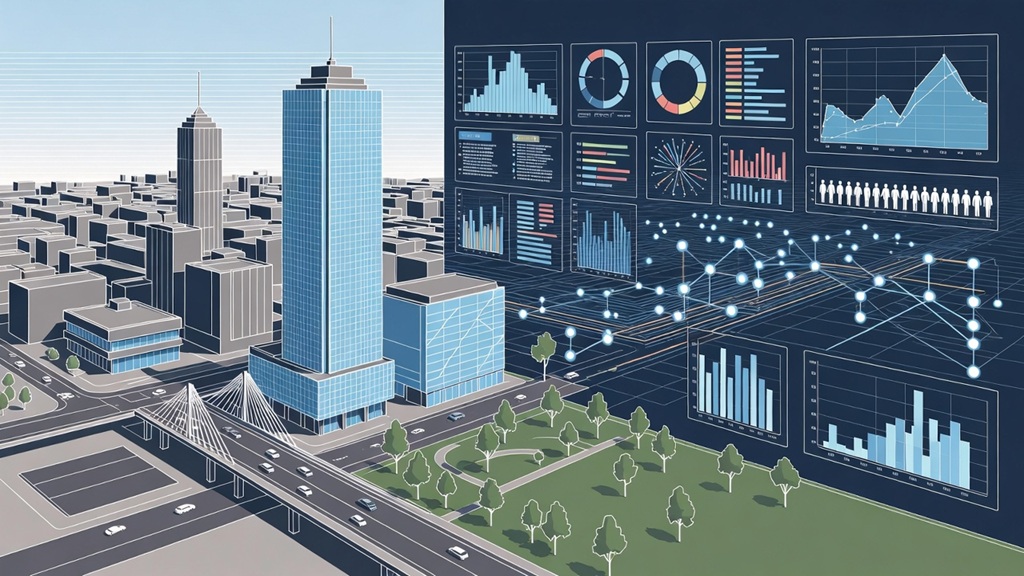
World Models in Urban Planning: Simulating the Physical City
For centuries, urban planning has been a game of retrospective guesswork. Planners design transit lines, zoning laws, and drainage systems based on historical data and static projections, only to watch real-world usage diverge wildly from expectations. Today, that paradigm is collapsing. At Artilecto, we are witnessing the rise of World Models and Large Quantitative Models that can simulate the entire physical fabric of a megacity at unprecedented fidelity.
These advanced computational engines do not merely predict trends; they simulate the laws of physics across millions of distinct data points. By integrating real-time sensor feeds with deep learning architectures, modern world models render the complex mechanics of urban life in high resolution. We can now simulate the cascading effects of a torrential downpour on subterranean drainage networks, model microscopic traffic friction during a mass evacuation, and calculate the urban heat island effect down to the individual building facade.
The true breakthrough lies in multi-physics simulation at scale. Simulating fluid dynamics for river overflows while simultaneously calculating thermodynamics for energy grids and agent-based modeling for pedestrian foot traffic used to require supercomputers running for weeks. Now, Large Quantitative Models compress these complex interdependencies into rapid, iterative simulations. Planners can test a thousand variations of a coastal defense wall or a congestion pricing zone before pouring a single yard of concrete.
This capability unlocks a future of resilient infrastructure built at zero marginal cost. Traditional trial-and-error in urban development is exorbitantly expensive and fraught with unintended consequences. Digital world models absorb the cost of failure. They allow cities to stress-test their infrastructure against extreme weather events and shifting population demographics in a virtual sandbox, optimizing for energy efficiency, economic vitality, and public safety simultaneously.
As our cities grow denser and climate volatility increases, relying on intuition is no longer viable. World models transform urban planning from a reactive art into a precise, predictive science. By simulating the physical city before we build it, we can design urban environments that are not only smarter and more efficient, but truly built to endure.
Ready to simulate your city’s future? Contact Artilecto today to explore our advanced urban planning solutions.