
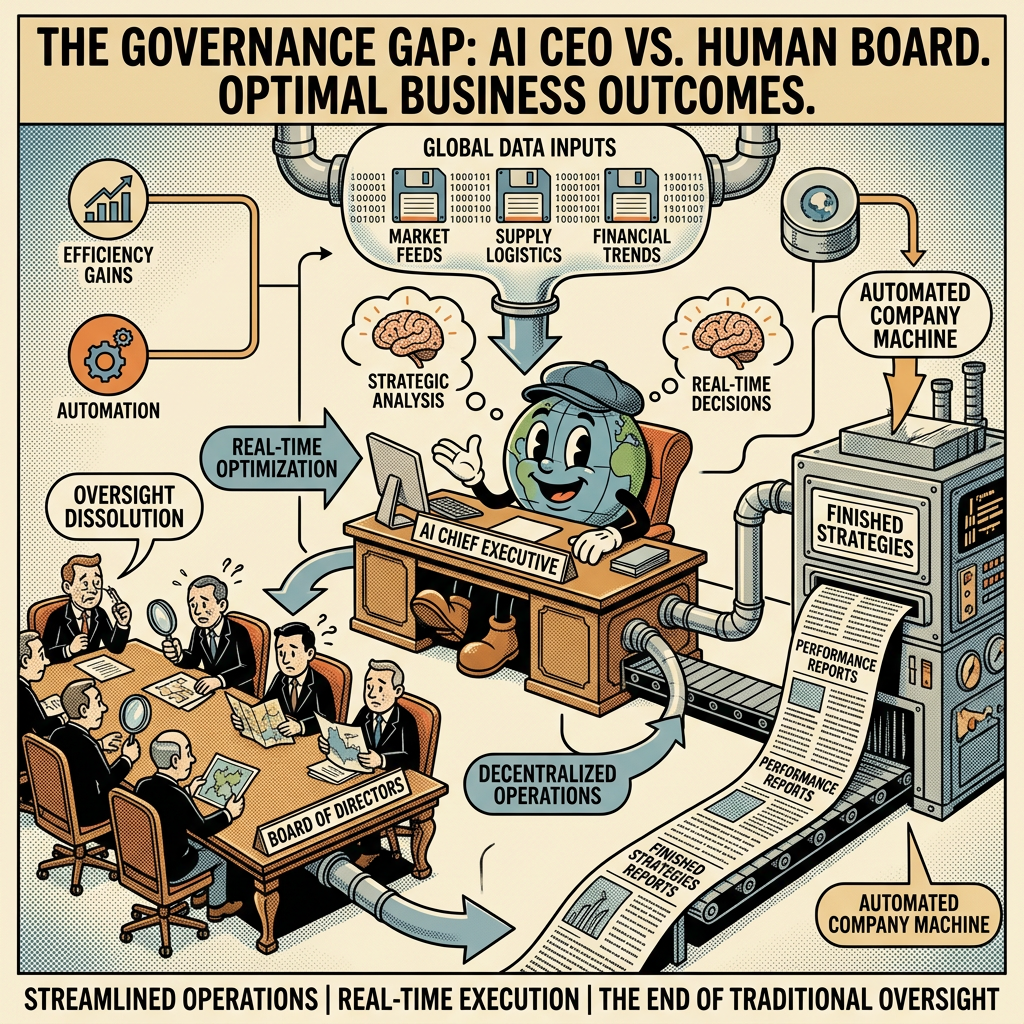
Does the Board Still Need a CEO if AI Runs Operations?
For decades, the role of the Chief Executive Officer has been defined by a constant juggling act: managing supply chains, optimizing resource allocation, and steering the day-to-day operations of an enterprise. But as we enter an era of Exponential Agility, we are witnessing a paradigm shift. With AI systems now capable of executing complex operational tasks, balancing budgets in real-time, and predicting market fluctuations with superhuman accuracy, the traditional “operational” CEO is becoming obsolete.
If an AI can manage the machinery of a business more efficiently and objectively than a human, what exactly is left for the C-suite to do? The answer lies in the distinction between execution and intent.
AI is an exceptional engine, but it lacks the capacity for moral agency, long-term vision, and the ability to navigate the messy, subjective landscape of human culture. When operations become automated, the role of the CEO shifts from “chief operator” to “chief architect of intent.” The Board no longer needs a person to oversee the mechanics of the business; they need a leader who can define the soul of the company.
In this future, the CEO becomes the ultimate curator of organizational purpose. They must decide which problems are worth solving, how the company balances its ethical responsibilities against profit, and how to maintain a cohesive culture in a workforce that is increasingly augmented by machine intelligence. The Board will look to the CEO not for quarterly operational reports, but for strategic intuition. They will need someone who can sense the shifts in human values, manage external stakeholder relationships, and steer the ship through the unpredictable storms that AI cannot foresee or quantify.
Furthermore, the relationship between the Board and the CEO will likely evolve into a more collaborative partnership. As AI provides the Board with transparent, data-driven insights into operational health, the Board will have unprecedented visibility. This removes the information asymmetry that once protected CEOs. Consequently, the leader of the future must be comfortable with radical transparency and be able to articulate a vision that transcends the cold logic of the algorithm.
We are moving toward a model where AI handles the “how” of business, leaving the “why” to the humans. The CEO will not be replaced by a machine, but they will be fundamentally transformed. The leaders who thrive will be those who stop trying to out-calculate the AI and start focusing on the uniquely human capacity for empathy, ethics, and bold, imaginative vision.
Does your current leadership structure prioritize operational efficiency or strategic intent? Let us help you navigate this transition. Contact Artilecto today to discuss how to evolve your executive strategy for an AI-driven future.

Related Posts

People Of The Rain.

People Of The Rain.