
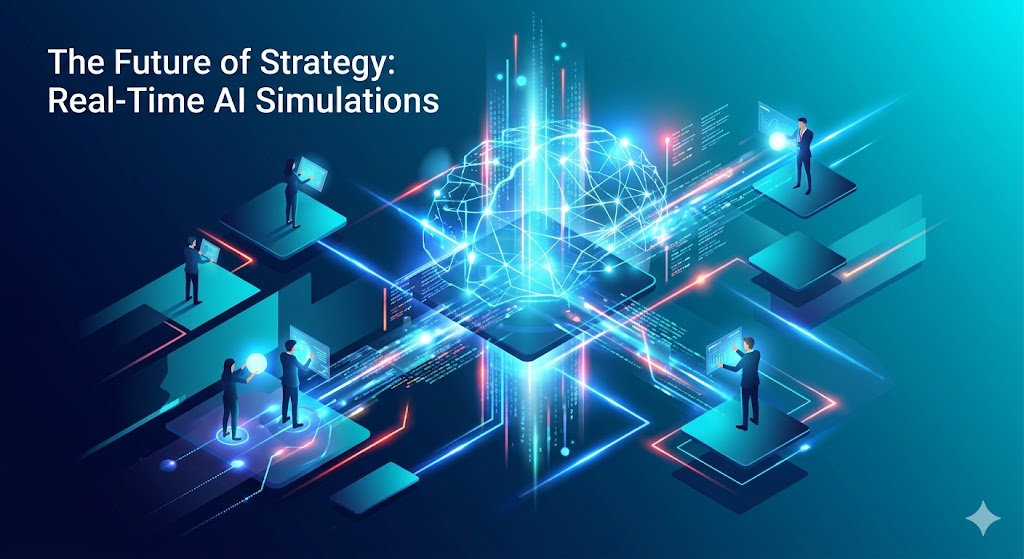
The Future of Strategy: Real-Time AI Simulations
For decades, strategic planning was a game of educated guesses. CEOs and boards would spend months analyzing historical data, debating forecasts, and building rigid multi-year plans. Once the strategy was set, capital was deployed, and the company was locked into a path that often proved difficult to pivot away from. In today’s volatile market, that traditional approach is no longer just slow; it is a liability.
Enter the era of real-time AI simulations. We are witnessing a fundamental shift in how leadership teams approach high-stakes decision-making. Instead of relying on static spreadsheets and intuition, forward-thinking CEOs are now utilizing digital twins of their businesses and markets to simulate outcomes before committing to massive capital investments.
These AI-driven simulations allow organizations to stress-test their strategies against thousands of potential scenarios. What happens if a new competitor enters the market? How will a sudden supply chain disruption impact our margins? What if consumer behavior shifts overnight? By running these simulations, leaders can observe the ripple effects of their decisions in a risk-free, virtual environment. This process reveals hidden vulnerabilities and identifies opportunities that would be invisible to the human eye.
The power of this technology lies in its ability to synthesize vast amounts of unstructured data. Modern AI models process global economic trends, sentiment analysis, and internal performance metrics simultaneously to create high-fidelity predictions. When a CEO uses these insights, they are not just making a choice; they are selecting the path with the highest probability of success based on a continuous stream of real-time intelligence.
However, adopting AI simulations is not merely a technical upgrade; it is a cultural transformation. It requires a move away from the ego-driven decision-making of the past toward a model of evidence-based agility. It demands that leaders become comfortable with probabilistic thinking rather than searching for a single, guaranteed answer.
For Exponential Agility, this is the final frontier of competitive advantage. Companies that learn to simulate their future will inevitably outpace those that are still guessing. By reducing the cost of failure through virtual testing, organizations can afford to be bolder, iterate faster, and invest with unprecedented confidence.
The future of strategy is no longer about predicting the future with certainty. It is about building the capacity to react to any future that emerges. Are you ready to stop guessing and start simulating your path to growth?
If you are ready to integrate AI-driven strategic modeling into your leadership workflow, reach out to our team today to schedule a consultation.

Related Posts

People Of The Rain.

People Of The Rain.