
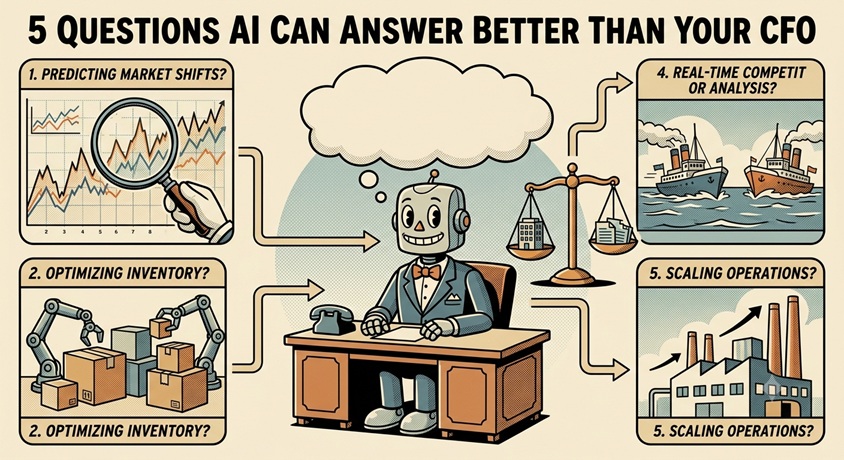
5 Questions AI Can Answer Better Than Your CFO
The role of the Chief Financial Officer is evolving. While human intuition and strategic oversight remain irreplaceable, the heavy lifting of financial data analysis is shifting toward artificial intelligence. Modern AI models are no longer just calculators; they are predictive engines capable of processing vast, unstructured datasets in seconds—a feat that can take a human finance team weeks to complete.
Here are five critical financial questions where AI is currently outperforming traditional human analysis.
1. What will our cash flow look like in eighteen months?
Traditional forecasting often relies on linear projections based on historical data. AI models, however, incorporate external market variables, supply chain disruptions, and macroeconomic trends to create non-linear, probabilistic forecasts. By identifying hidden correlations, AI provides a more accurate picture of future liquidity than a static spreadsheet ever could.
2. Which transactions are most likely to be fraudulent?
Human auditors typically rely on sampling, which leaves gaps for errors or malicious intent to slip through. AI-driven audit tools analyze 100 percent of your transactional data in real-time. By establishing a baseline of normal behavior, these models flag anomalies and high-risk patterns that human eyes simply cannot detect amidst millions of data points.
3. How will a price change affect our customer churn rate?
Predictive modeling allows AI to run thousands of simulations based on past customer behavior. Instead of guessing how a price hike might impact revenue, AI analyzes the elasticity of your specific customer segments, predicting churn probabilities with startling precision. It moves the conversation from gut instinct to data-backed certainty.
4. Which operational costs are truly unnecessary?
AI excels at pattern recognition within operational expenses. By scanning procurement data and vendor invoices, AI can identify redundant spending, unfavorable contract terms, or recurring inefficiencies that are often buried deep within departmental budgets. It finds the savings that humans are too close to the process to notice.
5. What is the impact of a specific supply chain disruption?
In an era of global volatility, scenario planning is vital. AI models can ingest real-time news, weather patterns, and port congestion data to simulate how a specific disruption will impact your bottom line. While a human CFO might estimate the impact, AI quantifies the precise financial exposure and suggests optimal mitigation strategies.
At Exponential Agility, we believe that the future of finance is not about replacing the human element, but augmenting it. By delegating these complex analytical tasks to AI, your finance team is freed to focus on high-level strategy and organizational growth.
Are you ready to integrate AI into your financial operations to drive better decision-making? Contact the team at Artilecto today to start your digital transformation.

Related Posts

People Of The Rain.

People Of The Rain.