
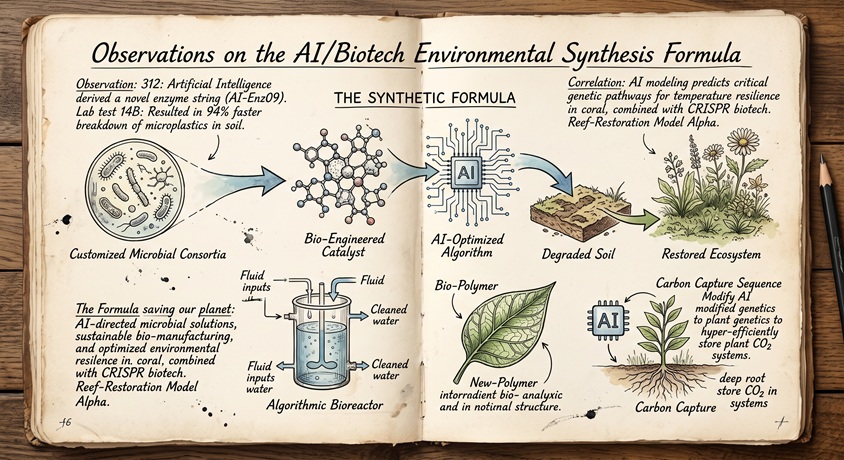
When AI Meets Biotech: The Formula Saving Our Planet
Climate change is the ultimate complex system. From unpredictable weather patterns to soaring global temperatures, the variables driving environmental degradation are vast and interconnected. Traditional scientific research often moves too slowly to outpace this crisis. Enter the powerhouse partnership of artificial intelligence and biotechnology, a convergence that is rewriting the rules of planetary survival and giving humanity a fighting chance.
At its core, biotechnology harnesses cellular and molecular processes to develop technologies that improve our world. However, finding the right biological catalysts in nature can take decades of trial and error. This is where AI changes the game. By leveraging machine learning models that can process massive datasets in seconds, scientists are now able to predict protein structures and design custom enzymes with unprecedented precision. We are no longer just discovering nature’s tools; we are intelligently engineering them.
A stunning breakthrough in this field involves the redesign of carbon-capturing enzymes. Industrial carbon capture has historically been plagued by high costs, immense energy requirements, and fragile materials that degrade quickly under harsh factory conditions. Recently, a team of researchers used generative AI to redesign natural carbon-eating enzymes, supercharging their stability and efficiency.
These AI-designed enzymes can now withstand high industrial temperatures and capture carbon dioxide from exhaust streams at rates hundreds of times faster than their natural counterparts. Imagine industrial smokestacks retrofitted with compact biological filters that actively pull greenhouse gases out of the air and convert them into harmless minerals or useful fuels. This is not science fiction. It is happening right now in labs around the world, proving that digital intelligence can successfully optimize biological solutions for the physical world.
The synergy of AI and biotech extends far beyond carbon capture. Researchers are currently deploying similar models to create biodegradable plastics that break down in weeks, develop drought-resistant crops to feed a warming planet, and engineer microbes that feed on plastic waste in our oceans.
As we look toward an uncertain climate future, the fusion of silicon and cells offers a beacon of hope. By letting algorithms do the heavy lifting of biological design, we are unlocking scalable solutions that can heal our ecosystem. The formula for saving our planet is being written line by line of code and strand by strand of DNA.
