
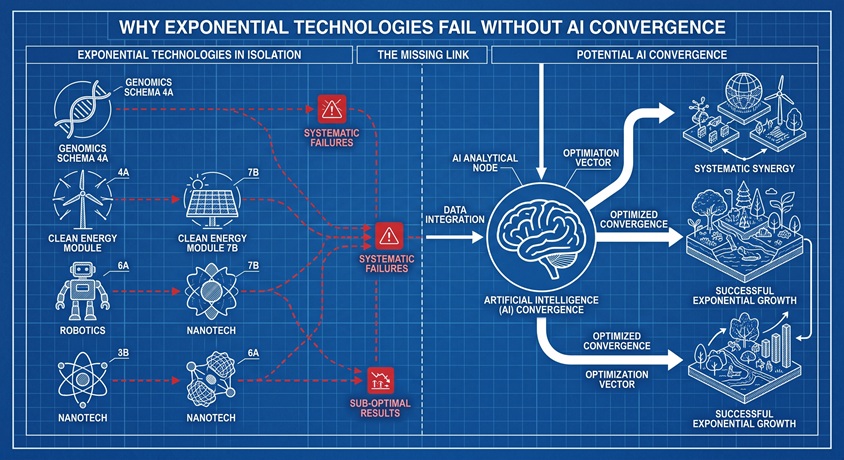
Why Exponential Technologies Fail Without AI Convergence
We live in an era of unprecedented scientific acceleration. Quantum computing promises to simulate molecular structures at unimaginable speeds. Biotechnology is cracking the code of life itself with CRISPR and mRNA. Nanotechnology and robotics are pushing the boundaries of what is physically possible. Yet, despite these monumental leaps, humanity is still waiting for the utopian future we were promised. Why are these exponential technologies failing to transform our daily lives at scale?
The root of the problem is fragmentation. For decades, scientific disciplines have operated in deep silos. A quantum physicist rarely speaks to a synthetic biologist, and a roboticist seldom collaborates with a materials scientist. Each field is generating vast oceans of data, but this information remains trapped within specialized domains. Without a bridge between these islands of innovation, progress is linear where it needs to be exponential.
Enter artificial intelligence. AI is not merely another tool in the scientific toolkit; it is the essential connective tissue required for global impact. Unlike human researchers, AI can ingest, synthesize, and extrapolate across entirely different domains simultaneously. It does not suffer from cognitive bias or the limitations of human specialization. By acting as a universal translator, AI bridges the gap between disparate fields and creates a unified framework for discovery.
Consider the pharmaceutical industry. Traditionally, discovering a single life-saving drug takes over a decade and billions of dollars. When you combine quantum computing with biotechnology, the theoretical possibilities explode. However, managing the sheer volume of variables is impossible for human minds. AI acts as the orchestrator, guiding quantum simulations to design novel proteins that biotech labs can synthesize and test instantly. This convergence turns a twenty-year pipeline into a weekend project.
When exponential technologies operate in isolation, they hit a cognitive and operational bottleneck. They generate more data than we can process, leading to paralysis by analysis. AI solves this by automating the synthesis of knowledge. It extracts patterns from quantum mechanics and applies them to materials science, or takes insights from robotics and optimizes biotechnology.
To solve humanity’s most complex challenges, from climate change to disease eradication, we must stop viewing AI as a standalone technology. It is the operating system for the next phase of human evolution. Only through AI convergence can we unlock the true potential of our most advanced scientific breakthroughs and turn theoretical promises into a reality.

Related Posts

People Of The Rain.

People Of The Rain.