Synthetic Biology: Programming Life to Clean Our Atmosphere
Humanity has spent centuries extracting carbon from the earth and releasing it into the sky. Now, a new technological wave is turning the biosphere into a sponge. Synthetic biology is moving beyond medical breakthroughs and agricultural enhancements. Scientists and engineers are designing custom microbes programmed to consume greenhouse gases on an industrial scale. This is not science fiction. It is a rapidly scaling commercial reality.
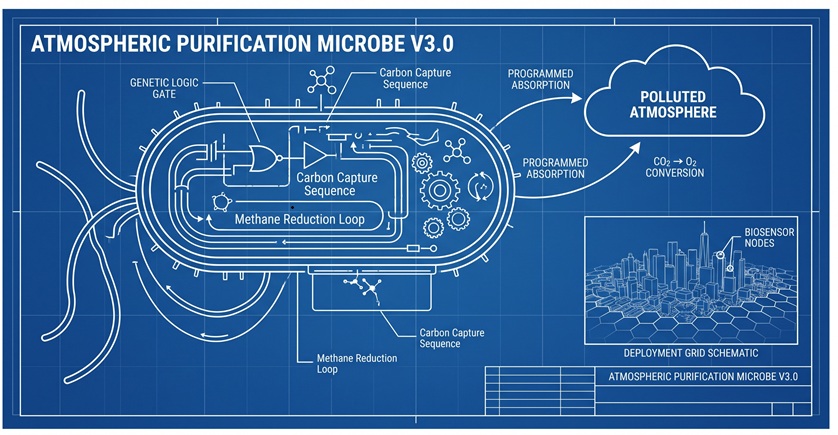
The engine driving this revolution is artificial intelligence. Natural evolution is too slow to address the climate crisis in time, but machine learning models can design novel enzymes and metabolic pathways in days. Researchers feed algorithms vast datasets of genetic sequences to engineer single celled organisms that thrive on carbon dioxide, methane, and industrial waste. These biological factories do not just capture carbon. They convert it into valuable chemicals, biodegradable plastics, and sustainable fuels.
Commercial milestones are accumulating fast. Several pioneering biotech startups have transitioned from laboratory benches to massive bioreactors. Venture capital and government grants are flowing into bio manufacturing facilities that look more like breweries than chemical plants. In these facilities, trillions of engineered microbes work around the clock, outperforming traditional industrial processes while leaving a minimal carbon footprint. We are witnessing the birth of a circular bioeconomy where waste gases become the primary feedstock for global manufacturing.
Ecologically, the implications are profound. Scaling up biological carbon capture offers a decentralized solution to emissions. Instead of relying solely on massive direct air capture machines made of steel and powered by electricity grids, we can deploy self replicating systems that scale organically. As these engineered strains become more resilient and efficient, they will be integrated directly into industrial smokestacks and agricultural facilities, transforming point source polluters into carbon negative nodes.
The convergence of artificial intelligence and genetic engineering has fundamentally altered our relationship with nature. We are no longer just observers of biological systems. We are programmers. By writing new code for life, we are building the tools necessary to repair our atmosphere and secure a habitable future. The greatest technological revolution of our time is microscopic, and it is just getting started.