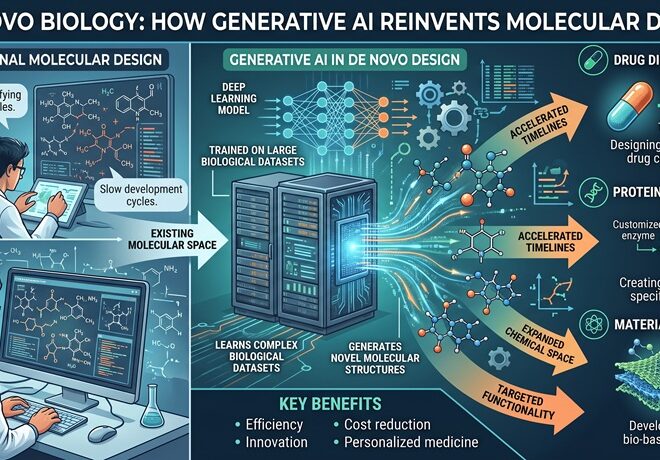
De Novo Biology: How Generative AI Reinvents Molecular Design
Historically, molecular engineering relied on modifying what nature already provided. Directed evolution reshaped existing proteins through iterative trial and error, a slow process constrained by natural evolutionary pathways. Today, generative AI is flipping this paradigm entirely through de novo biology. Instead of tweaking existing organisms, multimodal AI architectures are designing novel synthetic proteins and catalytic enzymes from scratch to solve humanity’s most intractable ecological and industrial crises.
This shift represents a massive leap beyond predictive tools. While earlier breakthroughs predicted how natural amino acid chains fold into structures, generative diffusion models and protein language architectures treat molecular physics as a generative canvas. By integrating sequence data, 3D atomic coordinates, and catalytic energy landscapes into multimodal frameworks, these models generate bespoke molecular machinery optimized for hyper-specific thermodynamic and chemical functions.
The most