
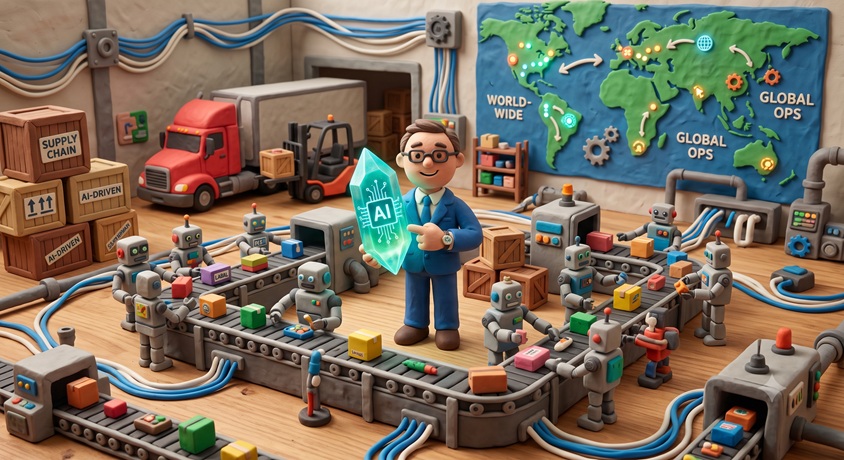
AI and the Supply Chain: A CEO’s Secret Weapon
In today’s volatile global economy, the supply chain is no longer just an operational concern—it is a strategic battlefield. CEOs who once viewed logistics as a back-office function are now realizing that the ability to navigate uncertainty is the ultimate competitive advantage. For leaders at Exponential Agility, the secret weapon in this endeavor is predictive AI.
For years, supply chains relied on historical data to forecast future demand. However, in an era of sudden geopolitical shifts, climate events, and fluctuating consumer habits, yesterday’s patterns are poor predictors of tomorrow’s reality. Traditional models often fail because they are reactive. Predictive AI, by contrast, acts as a forward-looking radar system, processing vast amounts of real-time data to identify risks before they manifest into full-blown crises.
One of the most significant impacts of predictive AI is the stabilization of supply networks. By analyzing everything from port congestion reports and weather patterns to social media trends and raw material availability, AI allows CEOs to shift from a mode of crisis management to one of proactive orchestration. When a disruption is detected, the system does not just alert the team; it suggests optimized rerouting, inventory adjustments, and alternative supplier pathways, often in seconds. This speed is critical for maintaining continuity when competitors are still scrambling to assess the damage.
Beyond stability, the financial case for AI is undeniable. Logistics costs are frequently inflated by inefficiencies, such as excessive safety stock, expedited shipping fees, and idle transport capacity. Predictive AI optimizes these variables by synchronizing supply with actual demand signals with pinpoint accuracy. This precision reduces the need for costly buffer stocks and helps companies move away from expensive last-minute logistics solutions. For the C-suite, this translates directly to improved cash flow and healthier margins, providing the capital necessary to reinvest in growth and innovation.
Furthermore, integrating AI into the supply chain fosters a culture of agility. It empowers decision-makers with data-backed insights, removing the guesswork that often paralyzes leadership during turbulent times. When a CEO can see the ripple effect of a potential disruption across the entire value chain, they can make informed, confident decisions that protect both the bottom line and the brand reputation.
As we look toward the future, the divide between companies that leverage AI and those that do not will only widen. Those that adopt predictive technologies are not just surviving uncertainty; they are using it as an opportunity to gain market share. Implementing these tools is not merely a technical upgrade—it is a fundamental shift in how a business survives and thrives in a complex world.
Is your supply chain built for the future or stuck in the past? Contact the team at Artilecto today to discover how we can help you integrate predictive AI and gain a decisive edge.

Related Posts

People Of The Rain.

People Of The Rain.