
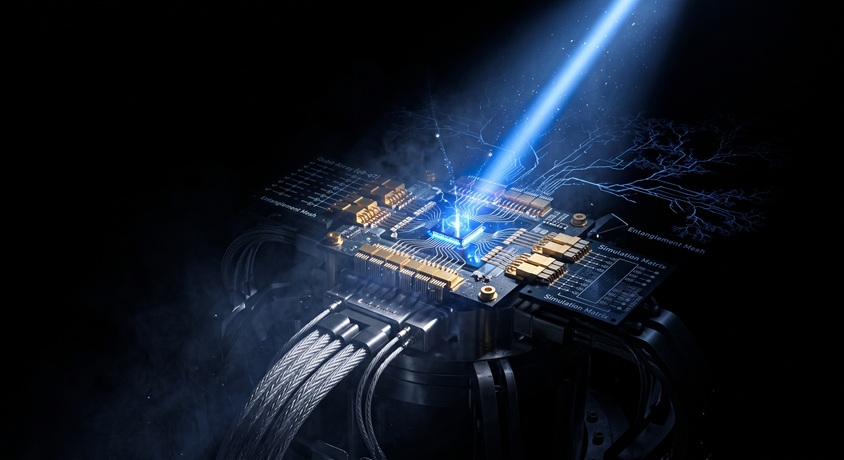
Quantum Processing + AI: Unlocking the Subatomic Simulation Engine
Classical supercomputers are hitting a brick wall when it comes to molecular modeling. Traditional machines calculate complex atomic interactions sequentially, making the simulation of large proteins, catalysts, and advanced materials virtually impossible. Nature itself does not operate on classical logic, and trying to simulate quantum mechanical systems with binary bits is like trying to run a modern 3D video game on a mechanical calculator.
Enter the symbiotic pairing of quantum processing and artificial intelligence. This architectural synergy represents the next frontier in computational science. While quantum hardware provides the raw, superposition-based horsepower needed to natively represent subatomic states, machine learning algorithms act as the intelligent navigators that tame quantum noise and optimize circuit design.
At the core of this breakthrough is the concept of the subatomic simulation engine. Quantum processors use qubits that can exist in multiple states simultaneously, perfectly mirroring the probabilistic nature of electrons and molecular bonds. However, extracting useful data from noisy intermediate-scale quantum devices is notoriously difficult. This is where AI steps in. Neural networks excel at recognizing patterns in vast, chaotic datasets, making them ideal for error correction, state tomography, and guiding quantum variational algorithms toward accurate ground-state energies.
By combining AI with quantum hardware, researchers can bypass the exponential scaling bottleneck of classical computing. Simulating the exact behavior of a drug molecule or designing a room-temperature superconductor shifts from an intractable lifetime project to an achievable computational sprint. Machine learning models learn from initial quantum outputs, predicting molecular configurations and narrowing down search spaces before committing them to the physical quantum processor.
This integration unlocks industrial applications across pharmaceuticals, material science, and clean energy storage. We are moving away from brute-force trial and error toward precise, predictive molecular design. The future of scientific discovery will not belong to classical supercomputers alone, but to the hybrid intelligence of quantum processors and artificial neural networks working in tandem.
Ready to explore the intersection of quantum computing and artificial intelligence for your enterprise? Contact Artilecto today to discover how our advanced simulation frameworks can transform your R and D pipeline.

Related Posts

People Of The Rain.

People Of The Rain.